Industrial Epoxy Floors for Woodbury and East Metro Businesses
Warehouses, service bays, kitchens, showrooms and shared parking garages. Each one gets a floor system specified around what rolls, spills and gets washed across it, and around the hours the space can close.
Industrial Epoxy Floors, the Short Version for Decision-Makers
- The space sets the system, not the brand. Forklift lanes, hot washdown, brake fluid and storefront sun each call for different thickness, chemistry and topcoat, and a few of those spaces shouldn’t get plain epoxy at all.
- Prep is most of the bid. Moisture testing, mechanical profiling to the data sheet’s CSP and joint work determine whether the floor holds. The resin is the smaller part of the job.
- Texture is a choice for each area. Smooth where it stays dry, gritted or broadcast where it gets wet, and heavy aggregate only where it needs to be.
- Downtime is a spec item. Ask for return-to-service hours for feet, forklifts and vehicles in writing, at the slab temperature you’ll actually have.
Industrial Epoxy Floors by Space: Warehouse, Kitchen, Showroom, Service Bay
Epoxy is only one family of resinous floor. Commercial work also uses urethane topcoats, polyaspartics, thick troweled mortars, and floors that skip a coating and get polished instead. Below is how each type of space usually gets handled, and the questions worth asking for each.
Pick the space
Five kinds of business floor, each with what wears on it and what to put in front of a bidder.
Warehouse and distribution floors
- Traffic
- Forklifts and pallet jacks on hard polyurethane or nylon wheels, which put a lot of load on a small contact patch. Pallets get dragged, racking feet sit in one spot for years, and the worst wear runs in lanes.
- Chemicals and heat
- Hydraulic fluid and oil drips, plus battery electrolyte in charging areas. Most of the floor stays at room temperature, but the slab by an unheated dock door gets cold every winter.
- Cleaning
- Ride-on or walk-behind auto-scrubbers and sweepers. A seamless, light-colored floor makes debris easy to see and brightens the aisles.
- Typical system direction
- A high-build epoxy, usually several coats thick, with line striping laid out after it cures, and a light grit in aisles that get wet. If the slab is sound and dust is the only complaint, polished concrete is worth pricing alongside it.
- What to ask
- How thick is the system in the forklift lanes, in mils?
- How are the saw-cut joints in the travel paths treated, and with what filler?
- Does racking have to move, or can the work go zone by zone around it?
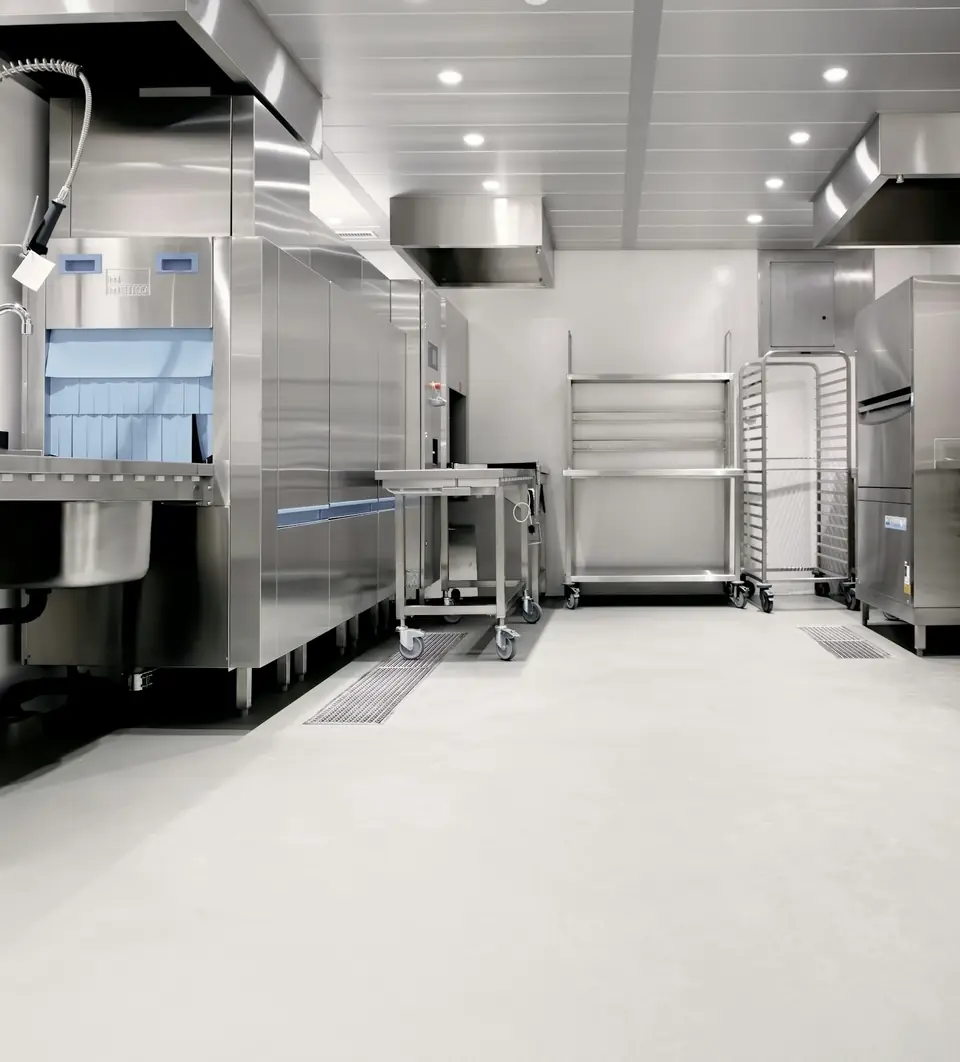
Commercial kitchen floors
- Traffic
- Constant foot traffic in wet shoes, loaded carts, dropped pans and the occasional dropped stockpot.
- Chemicals and heat
- Fats, oils, sugars, food acids and sanitizers, along with hot water, steam and the thermal shock of hot washdown water hitting a floor chilled by a walk-in cooler.
- Cleaning
- Daily hose-down and squeegee to floor drains, along with degreasers and hard scrubbing.
- Typical system direction
- This is the space where we’d steer you away from plain epoxy. Kitchens with hot washdown and thermal shock are often specified with urethane cement (cementitious urethane) troweled thick with an integral cove base. Thin epoxy films can crack or lose their bond under that cycle. As a published example, one cementitious urethane data sheet lists “Resistant to steam cleaning,” a 1/4 to 1/2 inch thickness and a thermal shock range of −350° to 400°F.
- What to ask
- Is the proposed system rated for your washdown temperature? Ask to see it on the data sheet.
- How high is the cove base, and how does it tie into the drain bodies?
- Does the bidder install urethane cement? If a bidder offers only epoxy for a hot-washdown kitchen, ask why.
Showroom and retail floors
- Traffic
- Mostly foot traffic. Display vehicles, furniture or equipment get moved around, and that is where scratches come from.
- Chemicals and heat
- Not much chemical exposure, except tire plasticizers under display vehicles. The bigger issue is sun coming through storefront glass, because plain epoxy yellows in UV light.
- Cleaning
- Dust mopping and a small scrubber. A high gloss shows every scratch and footprint, and some owners only find that out after it’s installed.
- Typical system direction
- An epoxy base under a UV-stable aliphatic topcoat (urethane or polyaspartic), in a solid color or a decorative metallic. Polished concrete is the other common route for a showroom.
- What to ask
- Which topcoat goes on the floor area near the windows?
- How will scratches look in six months, and what does a maintenance recoat involve?
- Can we see a sample board in our own lighting?
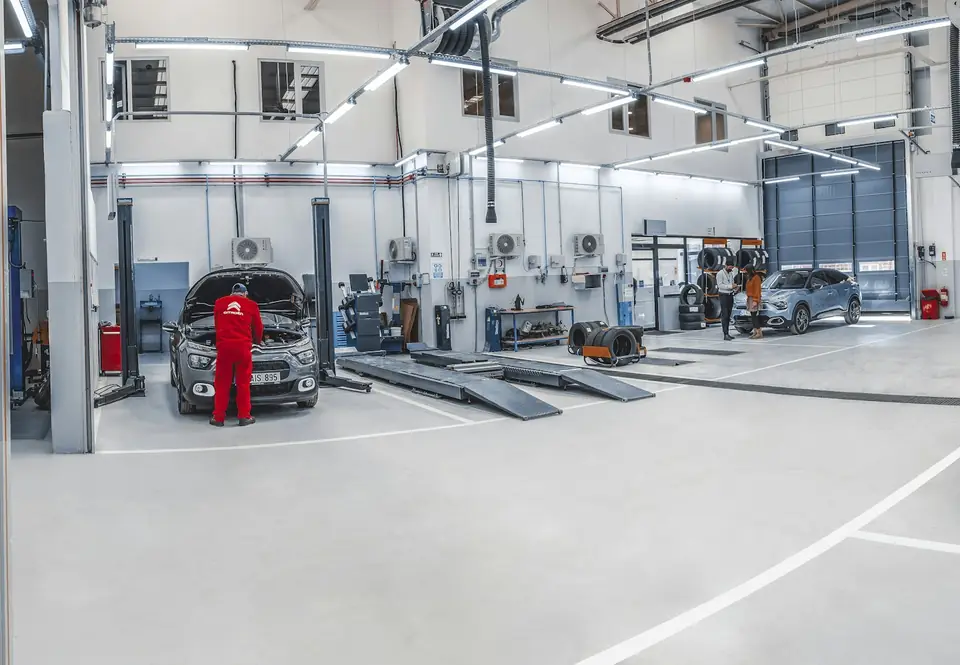
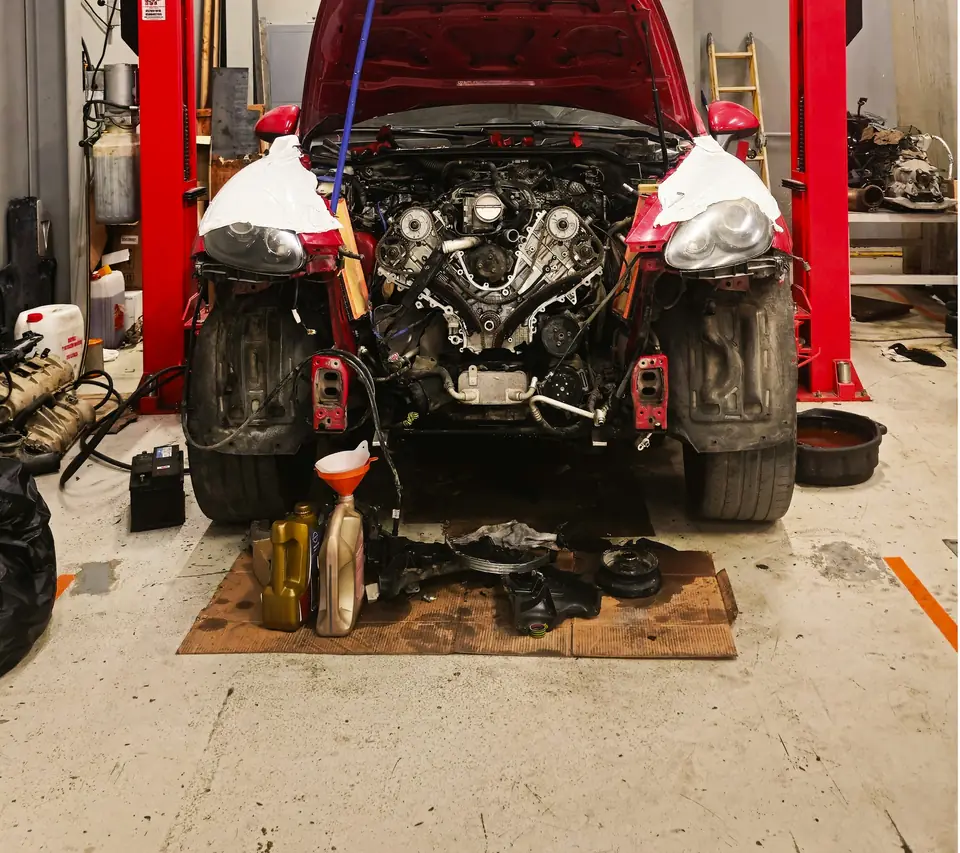
Auto shop and service bay floors
- Traffic
- Vehicles, jack stands, creepers, rolling toolboxes and floor jacks, plus hot tires off the road. Two-post lifts are anchored straight through the slab.
- Chemicals and heat
- Motor oil, transmission fluid, coolant, battery acid, brake cleaner and brake fluid, which softens some coatings. All winter, cars track in salt slush.
- Cleaning
- Degreaser, pressure washing, and squeegeeing to a trench drain.
- Typical system direction
- A high-build epoxy, or epoxy under a chemical-resistant urethane or polyaspartic topcoat, with a light grit or a broadcast in wet areas. Old oil-soaked concrete is the main risk: oil left in the pores can wick back up and lift the new coating.
- What to ask
- How will oil-soaked areas be cleaned and tested before coating?
- Do the lifts need to be unbolted? That decision belongs to a lift technician, not the coating crew.
- Ask for a chemical resistance chart that lists brake fluid and the solvents you actually use.
Clinic, dental and salon floors
- Traffic
- Foot traffic, rolling chairs and carts. Wear is light, but appearance matters.
- Chemicals and heat
- In salons: hair dye, peroxide, acetone and nail products. In clinics: disinfectants applied many times a day.
- Cleaning
- Frequent wet disinfecting. A seamless floor with a cove base leaves no grout lines or seams to clean.
- Typical system direction
- A thin seamless epoxy or urethane system with a stain-resistant topcoat. These spaces are usually in occupied multi-tenant buildings, so the odor of the product during install can matter as much as the chemistry.
- What to ask
- Could the bidder spot-test the topcoat with the dyes or disinfectants you use?
- What is the odor and ventilation plan if neighboring suites are open during the work?
General direction for each type of space, not a recommendation for your building and not a price. The slab, the products you clean with and the hours you can close decide the actual system.
How Much Texture a Wet Commercial Floor Needs
Slip resistance on a coated floor comes from texture: grit in the topcoat, a broadcast of flake or quartz, or coarse aggregate. Every step up gives more grip and makes the floor harder to clean. Most commercial floors end up with two or three textures in different areas, not one texture across the whole building.
Twin Cities winters make this worse at the entries. Snowmelt and slush come in on boots and tires from November to March, so the first stretch inside a dock door or an overhead door needs more texture than the middle of the room.
Traction ladder
Slide up from a smooth gloss to a heavy aggregate. Each rung buys grip and costs some ease of cleaning.
Level 1 of 4: smooth gloss
-
Smooth gloss
Where it belongs: Dry interiors: offices, dry showrooms, display areas, clean storage.
Cleaning trade-off: The easiest floor to clean, since a mop or scrubber pad glides over it. When it’s wet with snowmelt or spilled water, it is the slickest of the four.
No texture added. Grip comes only from the topcoat itself.
-
Fine grit mixed into the topcoat
Where it belongs: Warehouse aisles, light assembly, clinics, entry runs and the walk paths in a shop.
Cleaning trade-off: Mops still work but drag slightly, and a scrubber with a brush gets into the texture better than a flat pad.
Usually an aluminum-oxide additive. One manufacturer describes its product as “an aluminum oxide based anti-skid additive designed to provide skid resistance when added to Polycuramine, epoxy, latex or oil-based paints.”
-
Broadcast flake or quartz under a thin topcoat
Where it belongs: Service bays, locker rooms, wash-down corridors and parking areas.
Cleaning trade-off: Grip comes from the broadcast standing up through the topcoat. A thinner topcoat gives more grip and holds more dirt. Plan on a deck brush or a brush-head scrubber.
For comparison, one epoxy data sheet reports a coefficient of friction of 0.6 (ANSI 326.3) for its product. Ask any bidder which texture and topcoat a published number was measured on.
-
Heavy broadcast aggregate
Where it belongs: Ramps, vehicle wash bays, loading docks, the area around trench drains and the floor at cooler and freezer doors.
Cleaning trade-off: The hardest of the four to clean. It holds grit, chews up string mops, and is rough on knees and on anything dragged across it, so use it only where the floor is wet most of the time.
Remember that the familiar 0.42 wet DCOF figure (ANSI A326.3, developed by the Tile Council of North America) is a tile benchmark, and its own publisher notes that meeting it doesn’t make a surface suitable for every project.
Texture guidance only. No coating has a single slip number: it depends on the texture, the topcoat over it, the contaminant (water, grease, slush) and the footwear. Ask for a sample board with the actual broadcast before you decide.
Commercial Garage Floor Coatings for Parking, Fleet and Multi-Unit Garages
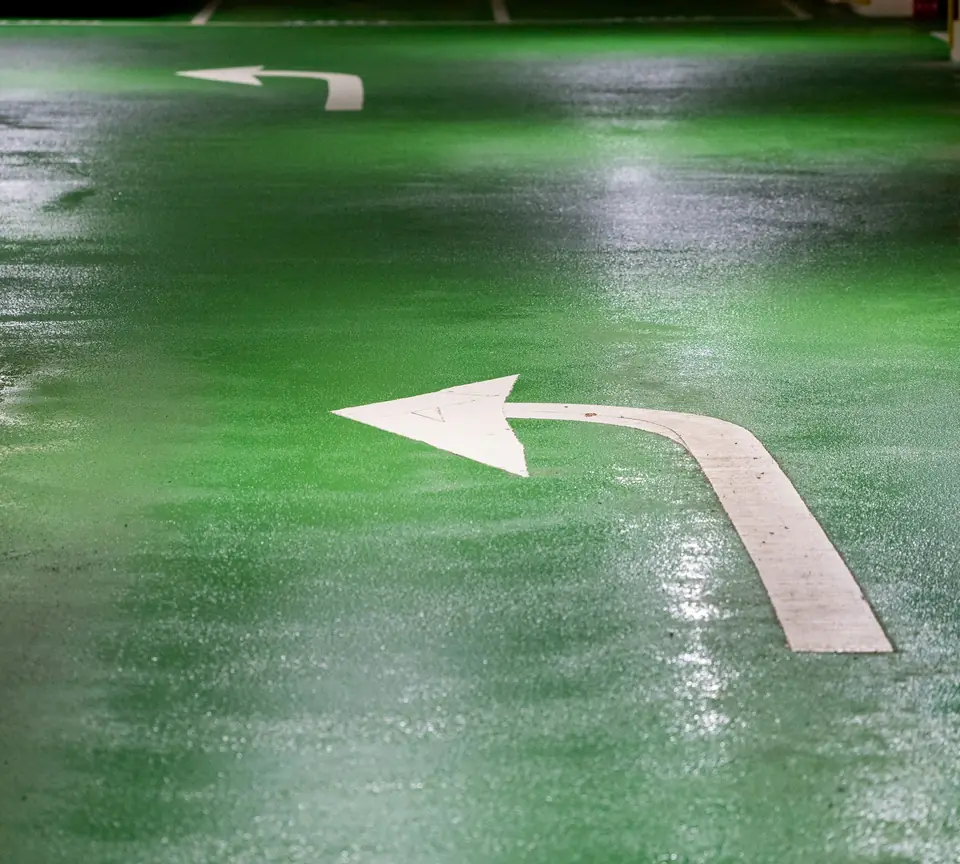
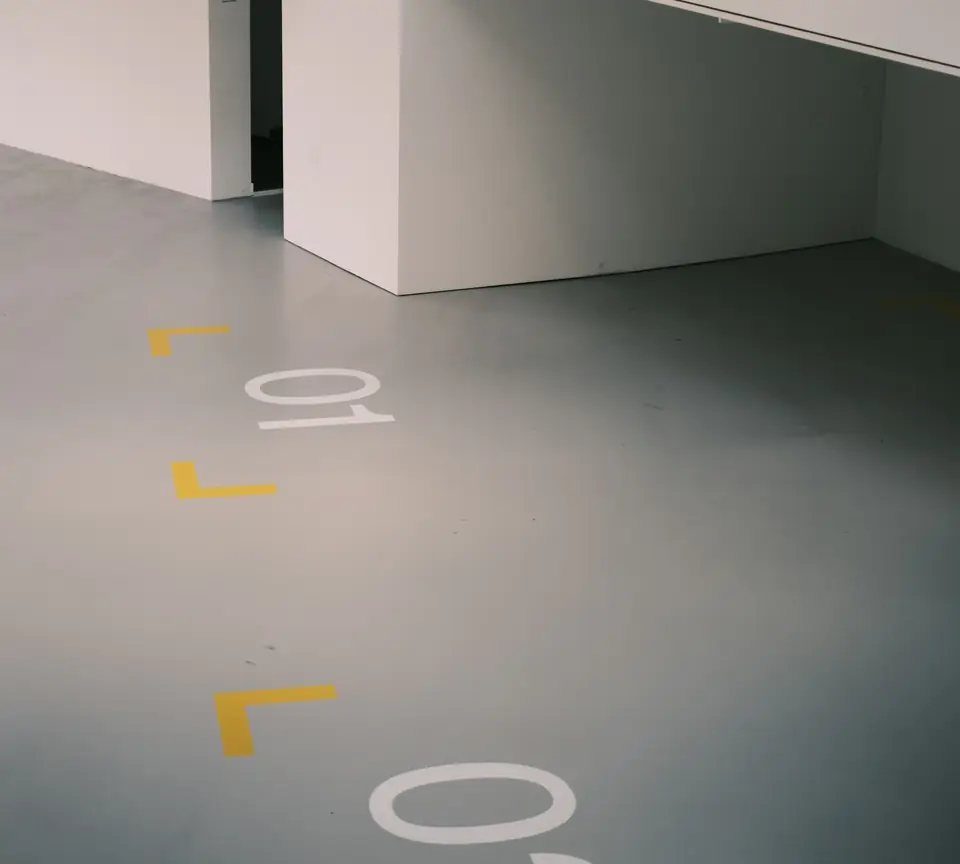
Underground parking under apartments and condos, fleet bays for service vans, and the shared garage of a townhome association all have more in common with a commercial floor than with a house. The cars belong to many different people, nobody squeegees, and the floor has to last between budget cycles. The system is related to the garage floor coating for homes, but it’s built thicker and laid out differently.
Deicing salt from vehicles
All winter, every car brings in brine on its tires and wheel wells, and in a shared garage that meltwater sits in the drive lanes. The Pennsylvania Aggregates and Concrete Association notes that “Deicers tend to amplify freeze-thaw deterioration,” and the MPCA lists vehicle and structural corrosion among the costs of road salt. A coating that’s bonded and continuous keeps that brine on the surface where it can be washed off. One polyaspartic topcoat sheet describes its product as “Impervious to water and deicing salts.” The ramps and the first bays inside the entrance wear first, so they usually get the heaviest texture.
Drains and slope
A coating follows the slope of the slab; it doesn’t correct it. Water that ponds on bare concrete will pond on the finished floor too. Ask the bidder where the coating stops at each floor drain or trench drain and how it is keyed in. Leveling or re-sloping the slab is concrete work, done before any coating goes down.
Line striping
Stall lines, stall numbers, pedestrian walkways and no-parking zones go on after the coating has cured enough to tape over. Bring a layout drawing, because a striping crew can’t guess where accessible stalls and fire lanes belong, and moving a stripe afterward means grinding it off.
Write the Industrial Floor Coating Spec Before You Collect Bids
Without a spec, three bidders will send three different systems at three thicknesses with three different prep methods, and the cheapest one usually skipped the most. Give every bidder the same list and the bids become comparable. The list below works whoever you hire, including the concrete coating contractors we compete with.
Spec note
Untick anything that doesn't apply to your building. The text block updates; paste it into your bid request.
A checklist of questions, not a specification sealed by an engineer or architect, and not our offer. Where a data sheet sets a number (moisture limit, profile, cure time), the bidder's product sheet is the source.
Commercial Floors in a Growing Woodbury and East Metro
Woodbury’s population went from an estimated 75,105 in April 2020 to 81,558 in July 2025, and Washington County passed 286,000 over the same period. Growth like that fills retail bays, medical suites, restaurants, self-storage and apartment parking, and every one of those buildings needs a floor that someone has to specify.
Some of it comes through redevelopment. City Place, at Radio Drive and I-94, is a mixed-use project on the “long-vacant, 100-acre site that was formerly home to State Farm Insurance,” in the words of the 2014 article that announced it. Projects like that bring a mix of new slabs and renovated older ones, and the two need different prep.
New slab, new tenantA fresh tenant build-out often happens on concrete poured only weeks earlier, and moisture is the most common reason a coating fails on it. Test it against the product’s own limit before the coating date goes on the construction schedule. That may push the flooring back a week, but it’s better than a floor that blisters and has to be redone.
We work across Woodbury, Cottage Grove, Oakdale, Lake Elmo, Maplewood and St. Paul’s east side. For a large plant floor that needs crews on several shifts at once, we’ll tell you at the walk-through if the job is beyond what we can staff.
Scheduling Industrial Floor Work Around Shifts, Tenants and Cold Months
Most businesses can’t close for a week, so commercial floors are usually phased. A warehouse is done one bay or aisle at a time while stock moves around the work. A restaurant is done in the hours it’s closed, front of house one night and the kitchen another, if the product’s cure allows it. An apartment garage is done one level or wing at a time, with notices to residents and somewhere for them to park.
The cure clock depends on the slab temperature. As one published example, an epoxy data sheet lists foot traffic after about 12 hours at 68°F and about 24 hours at 50°F, with light traffic after about 2 days and about 3 days. A cold slab can double the downtime. Twin Cities (MSP) normal highs stay below 42°F from November through March, so an unheated dock or parking level has to be heated, and held there, for days before and after the work, or the job moves to warmer months.
Summer has its own limit. Every data sheet we cite wants the slab at least 5°F above the dew point, and Twin Cities summer dew points usually peak in the mid to upper 70s. Open a dock door on a humid July day and a cool slab can sweat under the new coat. That’s why the temperature and dew point log is in the spec, and why a crew may stop work on a day that looks perfectly fine.
Polyaspartic topcoats shorten the wait. One polyaspartic data sheet lists vehicle traffic after about 24 hours at 77°F. They also leave the crew less working time on install day. For a general picture of how a coating job runs from first visit to cure, see how our epoxy floor installers work on homes and businesses.
Commercial Floor Estimates in Woodbury and the East Metro
Tell us what the space is, roughly how big it is, what is used and cleaned on the floor, and the hours it can be closed. If you already have a spec, mention it and we’ll bid against it line by line. If you don’t, the spec note above is a reasonable place to start.
- A walk-through of the floor before any price
- A written scope that names the system, thickness, prep and return-to-service times
- A straight answer if polished concrete or another trade fits better
Rather call? (651) 661-4781 or info@woodburyepoxyflooringpros.com.
What Facility Managers Ask Before an Industrial Floor Goes Down
Can a business stay open while the floor is done?
Often, by splitting the floor into zones and working nights or weekends, with the open areas closed off. What usually limits it is odor and dust: grinding is loud and dusty even with vacuum extraction, and some products smell while they cure. Ask each bidder for a zone plan and the return-to-service time for each zone.
Is epoxy the right choice for a restaurant kitchen?
For a dry storage room or a front-of-house floor, it can be. For the cook line and dish room, where there is hot washdown and thermal shock, urethane cement is the more common spec, because thin epoxy films tend to crack or lose their bond under that cycle. Whatever you choose, make sure the data sheet lists the temperature your washdown actually reaches.
Do you need a permit to coat a commercial floor in Woodbury?
Minnesota’s building code exempts finish work such as painting and tiling from building permits, and a coating applied over an existing slab counts as finish work. Adding new trench drains, changing the slab or moving electrical is different, and food businesses should ask their health inspector about floor and wall-base finishes before choosing a system.
How long before forklifts can drive on a new industrial floor?
That depends on the product and on the slab temperature, which is why the spec should ask for the forklift date separately from the walk-on date. As a published example, one epoxy data sheet lists light traffic after about 2 days at 68°F and about 3 days at 50°F, with full cure after about 7 to 10 days. Heavy steel-wheel loads should wait for full cure.
Will a coating stop dust on an old warehouse slab?
Yes, any bonded coating seals in a dusting surface. But if the slab is sound and dust is the only problem, densifying and polishing the concrete may cost less over the life of the floor and leaves no film that can wear through in the forklift lanes. If that’s the better buy for your building, we’ll tell you so.
Do you price commercial floors per square foot over the phone?
No. Two floors of the same size can differ by days of prep once moisture, oil contamination, joints and downtime limits are known. We look at the floor and the schedule first, then put a written scope against your spec.
Sources and data sheets cited on this page
- Sikafloor-264 product data sheet (epoxy example: CSP, moisture limits, cure times, coefficient of friction): industry.sika.com/content/dam/dms/us01/g/sikafloor_-264.pdf
- Shock-Crete HD product data sheet, Dudick / Carboline, July 2026 (urethane cement example): msds.carboline.com/servlet/FeedFile/1/prod/318D/PDS%3A%7BPC%3A318D%3BMID%3A1%3BLID%3A1%7D/Shock-Crete_HD_PDS.pdf
- Ghostshield Epoxy Max 100 TDS (application window example): cdn.shopify.com/s/files/1/2077/9359/files/100_TDS_v.1.pdf
- APF Polyaspartic 7500 Low Odor PDS (vehicle traffic example): apfepoxy.com/cdn/shop/files/APF_Polyaspartic_7500_LowOdorMC_PDS__07.18.25.pdf
- Sikalastic-748 PA PDS (deicing salts, early traffic): usa.sika.com/content/dam/dms/us01/r/sikalastic_-748_pa.pdf
- Rust-Oleum Anti-Slip Additive TDS (aluminum oxide): images.homedepot-static.com/catalog/pdfImages/d9/d9d61082-cb14-498f-9542-39453bba47ab.pdf
- ANSI A326.3 and DCOF 0.42 explained (Crossville, tile): www.crossville.com/learn/porcelain-tile-dcof-ratings-and-applications/
- ASTM F1869 (moisture vapor emission rate): store.astm.org/f1869-23.html
- ASTM F2170 (in-slab relative humidity): store.astm.org/f2170-19a.html
- Concrete surface profile visual scale (Clemtex, after ICRI): archive.clemtex.com/literature/files/concrete-surface-profile-visual-scale.pdf
- Deicers and concrete scaling (PACA): www.pacaweb.org/uploads/documents/PIS_Scaling.pdf
- Statewide Chloride Management Plan summary (MPCA, 2020): www.pca.state.mn.us/sites/default/files/wq-s1-94a.pdf
- NOAA 1991-2020 monthly normals, MSP: www.ncei.noaa.gov/data/normals-monthly/1991-2020/access/USW00014922.csv
- Twin Cities summer dew points (MN DNR): www.dnr.state.mn.us/climate/twin_cities/mspdewpoint.html
- Woodbury and Washington County population, Census Bureau Vintage 2025: www2.census.gov/programs-surveys/popest/datasets/2020-2025/cities/totals/sub-est2025_27.csv
- City Place redevelopment at Radio Drive and I-94 (Twin Cities Business, 2014): tcbmag.com/mixed-use-project-will-revive-100-acre-property-images/
- Minnesota Rules 1300.0120 (permit exemptions): www.revisor.mn.gov/rules/1300.0120/