Polyaspartic Garage Floor Coating in Woodbury, MN
A fast-cure, sun-stable topcoat for garages where the car can’t sit in the driveway for a week. It shortens the wait; it does not shorten the prep, and on some slabs it isn’t the right buy at all.
Polyaspartic Flooring: What the Coating Actually Is
Polyaspartic is a two-part coating, like epoxy, but it is a different chemistry. Three words on the data sheets explain most of what you’d be paying for. Aliphatic means it holds its color in sunlight instead of ambering the way many epoxies do; one manufacturer sells its version as “UV stable to ensure long-term gloss retention and resistance to yellowing.” High-solids means most of what goes on the floor stays there as film (that same sheet lists 75% solids by volume, rolled at 5 to 6 wet mils). Fast cure is the headline: the same sheet lists vehicle traffic after about 24 hours at 77°F.
In practice, polyaspartic flooring in a garage almost always means a topcoat. That manufacturer says its product is “ideally suited for use as a finish coat in decorative flake and color quartz flooring systems,” and its limitations section is blunt: “Use only on primed substrates. Do not apply directly to concrete.” The base underneath, and the grinding under that, do the bonding. The polyaspartic is the wear layer you see and drive on.
A second sheet, for a clear polyaspartic traffic coat used over flake and aggregate in parking structures, lists it as “Impervious to water and deicing salts.” That matters in a Woodbury garage, where salt slush rides in under every car from November to March. On bare concrete that brine soaks in; on a sealed topcoat it sits on the surface until you push it out the door and sweep up the residue, which is kinder to a city whose Battle Creek and Carver Lakes are already listed as chloride-impaired. The same sheet is honest about limits, though: “Vehicle fluids, some high performance tires, and some foods and beverages can stain the coating,” and opening to traffic before final cure “may result in loss of aggregate, or permanent staining.” Fast does not mean bulletproof.
If you’re still deciding between coating systems in general, our page on full garage floor coating systems covers solid, flake and clear builds over epoxy, and the main epoxy floor coating overview covers basements and shops too.
Polyaspartic Coating vs. Epoxy: What You Gain, What You Give Up
Most garage systems sold as “polyaspartic” and most sold as “epoxy” share the same prep and often the same base. The real choice is the top layer, and it is a trade, not an upgrade on every axis. Some priorities clearly favor a polyaspartic top, a couple favor epoxy, and a few come out even once you read the sheets.
Trade-off scale
Pick the priority you care about most. The beam tips toward the topcoat that serves it better, and the reason shows underneath. All seven reasons are listed, so you can also just read them.
All seven priorities are listed below.
- Speed back to parking: Tips hard toward polyaspartic-topped
- This is the reason the chemistry exists. One polyaspartic data sheet lists vehicle traffic after about 24 hours at 77°F. One epoxy sheet lists light traffic after about 2 days at 68°F and about 3 days at 50°F, and that is foot and light traffic, not a car.
- Color stability in sun: Tips toward polyaspartic-topped
- Both polyaspartic sheets we cite are aliphatic. One calls itself “UV stable to ensure long-term gloss retention and resistance to yellowing”; the other lists “superior color and gloss retention.” A 100%-solids epoxy sheet, by contrast, says a topcoat is recommended “for added UV stability.” A west-facing door left open on summer afternoons is where this shows.
- Working time on install day: Leans toward epoxy-topped
- Closer than the marketing on either side suggests. One polyaspartic sheet gives about 20 to 30 minutes of pot life at 77°F and warns that work life is “considerably shortened over 90°F.” Another gives 45 to 60 minutes at 75°F. An epoxy example gives about 25 minutes at 68°F but about 50 at 50°F. The lean is toward epoxy because a fast topcoat punishes a big batch or a slow roller more.
- Moisture tolerance: Tips toward epoxy-topped (really: toward the base coat)
- Whatever touches the concrete has to handle the moisture coming out of it. One polyaspartic topcoat sheet says “Use only on primed substrates. Do not apply directly to concrete”; another says not to apply “to a porous or damp surface where moisture vapor transmission will occur.” An epoxy base or primer with a published moisture limit (one sheet lists 85% by ASTM F2170) is usually what carries that load.
- Cold-weather install: Stays level, with a catch
- Less difference than people expect. One polyaspartic sheet allows application down to 40°F, the other stops at 50°F, and the epoxy examples we cite stop at 40°F and 50°F too. The sheets that publish a schedule all slow down as it gets colder. The catch: one polyaspartic sheet warns that kerosene or propane forced-air heaters “may cause discoloration and finish defects,” so warming a cold garage the quick way can spoil the topcoat you paid extra for.
- Odor: Stays level
- Both families sell low-odor versions: the polyaspartic sheets we cite are labeled “Low Odor” and “low odor,” and one epoxy sheet says “Solvent-free, low odor.” One polyaspartic sheet still tells installers to keep vapors out of the building by shutting and sealing air intakes. In an attached garage with a furnace or a door into the kitchen, that is part of the job either way.
- Cost: Stays level until you have two prices
- We won’t tip this one with a number we can’t source. The prep, repairs and base coat are the same work under either topcoat, so the difference sits in one layer and one day. The honest way to see it is to ask each bidder to price both topcoats over the same prep and the same base, side by side.
Guidance drawn from published data sheets, not a recommendation for your slab. Product figures are examples from other manufacturers’ sheets, not specifications of anything we install.
Polyaspartic Epoxy Systems and What Goes Under the Topcoat
“Polyaspartic epoxy” is a phrase you’ll see on bids and ads, and it isn’t one product. Polyaspartic isn’t a kind of epoxy. When people use the phrase they almost always mean a system: an epoxy base bonded to the concrete with a polyaspartic topcoat over it. There are two other common recipes, and the difference between them is mostly what touches the slab and how the day is scheduled.
Flake is the usual middle layer in all three. If the look and grip of the chips is the part you care about, the epoxy flake floor page goes through chip size, broadcast and texture.
Base-coat recipes
Three ways a polyaspartic topcoat ends up on a floor. Pick a column heading to highlight that recipe.
| Question | |||
|---|---|---|---|
| What goes on the concrete | A two-part epoxy base or primer, worked into the freshly ground slab. The polyaspartic never touches bare concrete. | A fast-cure base made for direct-to-concrete use, so the same day can carry base, broadcast and topcoat. | Nothing new. A sealed, flake or epoxy floor that is still well bonded stays in place and becomes the base. |
| Prep it needs | Diamond grinding to the profile the epoxy base’s data sheet names, cracks and pits filled and ground flush. | The same grinding and repairs, with fast-setting patch materials so repairs don’t hold up the base coat. | Cleaning and degreasing, then sanding the old surface dull so the clear can grip. Lifted or peeling spots get cut out first. |
| Moisture question to ask | What did the slab test at, and what is this base’s published moisture limit? | Is this base rated for the moisture this slab tested at, and what is the plan if the slab fails the test that morning? | Has the old coating lifted, blistered or whitened anywhere? Those are often moisture or bond problems a clear coat will seal in. |
| Typical schedule shape | Usually two working days: base (and broadcast) on day one, topcoat after the base reaches its recoat window. | One long working day, an overnight cure, and vehicles after the topcoat’s published traffic time. | A short visit: clean, sand, roll the clear, then the same wait for vehicle traffic as any polyaspartic topcoat. |
| Where it fits | Older slabs with question marks, lower levels and walkouts, and anyone who would rather give up a day than give up margin. | A sound, dry, tested garage slab where getting the cars back inside quickly matters most. | A floor that is in good shape underneath but dull, scratched or yellowed on top. |
Read the topcoat’s own sheetOne polyaspartic topcoat data sheet says it plainly: “Use only on primed substrates. Do not apply directly to concrete.” So ask what is under the topcoat, by name, and whether that base is made to go on bare concrete.
Qualitative comparison for planning the conversation, not a recommendation for your slab. The right recipe depends on the moisture test, the slab and the products named in a written bid.
How a Polyaspartic Garage Floor Goes In, Hour by Hour
The “one day garage floor coating” you see advertised is real, with an asterisk: it is one long day of work, then a night and most of the next day of cure before the car goes back in.
Here is how that day is usually laid out on a sound, dry two-stall slab. Look where the time goes: most of the morning is grinding and repairs, which are identical under any topcoat. The fast chemistry only compresses the afternoon and the wait. A cold slab stretches every line after the base coat.
One-day log
How a fast polyaspartic install on a sound two-stall slab tends to run in mild weather. Drag the clock, or open any entry.
-
Arrive and protect
Cars out, shelving and bins out or to the middle, walls and the door to the house taped and masked. Before anything is mixed, the crew reads air temperature, slab temperature and humidity and works out the dew point.
-
Grind
Diamond grinding opens the whole slab, edges and corners included, and takes off any builder’s sealer. On a two-stall garage with sound concrete this is the biggest block of the morning; a pitted apron or an old coating makes it longer.
-
Vacuum
Every bit of grinding dust comes up. A topcoat bonds to whatever is on the surface, and dust is not a surface.
-
Crack fill and patch
Cracks, pits by the door and spalls get a fast-setting repair material, then are ground flush. Moving joints are a separate conversation; they get a flexible fill or are left open.
-
Base coat
The base goes down in small batches, edge first, then the field. The temperature and dew point check happens again here, because the slab has warmed or cooled since morning.
-
Broadcast
Flake or quartz is thrown into the wet base, usually until it won’t take any more. That full broadcast is what hides tire marks and gives grip.
-
Scrape and blow off
Once the base has hardened, loose chips are scraped, swept and vacuumed off. Skipping this leaves sharp edges sticking up through the topcoat.
-
Topcoat
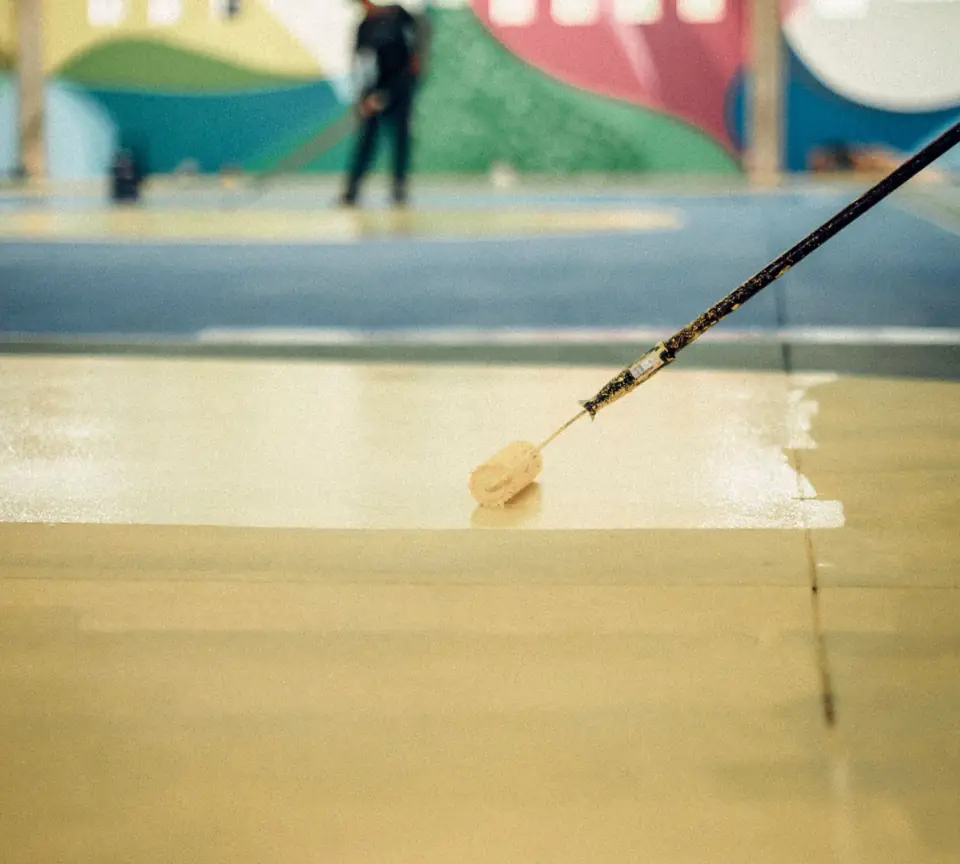
The polyaspartic clear is mixed by drill, poured and back-rolled with a wet edge. One data sheet asks for 5 to 6 wet mils, rolled twice in crossing directions, and warns against rolling over material that has begun to set.
-
Pack up and walk through
Tape comes off, the house door is reopened, and you get the times for walking and parking in writing. One sheet lists dry to touch at about 2 to 3 hours and light traffic at about 4 to 6 hours, both at 77°F.
-
Cure overnight
The garage door stays closed, the cars stay out. In a cool garage the clock runs slower: the same sheet notes that lower temperatures and higher humidity increase cure time.
-
Next morning: walk, don’t park
Foot traffic is fine by now in mild weather. Putting things back on the floor can wait; heavy shelving and car tires are the hardest test the new topcoat gets.
-
Next afternoon: cars back in
One polyaspartic data sheet lists vehicle traffic at about 24 hours at 77°F, counted from the topcoat, so a 3 pm topcoat means mid-afternoon the next day, not first thing in the morning. Full cure on that sheet is about 72 hours.
An illustration of how the day is usually laid out, not a schedule for your garage. Slab repairs, a cold or humid day and the specific products can move every line, and a slab under 50°F can push the cars-back-in line out by a day or more.
Polyaspartic Topcoats in Minnesota Heat, Humidity and Cold
Every sheet we cite sets the same three gates, and a Twin Cities year closes each of them at some point. Your installer should be measuring all three on the slab the morning of the job, not checking a weather app the night before.
- Temperature: 40°F to 50°F minimum
- One polyaspartic sheet allows 40°F to 90°F for air and slab, the other 50°F to 85°F. Concrete lags the air: a garage slab after a cold night is often colder than the afternoon reading suggests.
- Humidity: 80% or 95% maximum, depending on product
- One sheet says “Do not apply material if the humidity is over 80%”; the other allows up to 95%. Same family, different limits, which is why the product name belongs on the bid.
- Dew point: at least 5°F of margin
- Both want the surface at least 5°F above the dew point, so moisture can’t condense on the slab while the coating cures.
- Heat: work life shrinks fast
- One sheet warns “Work life is considerably shortened over 90°F.” MSP averages 12.5 days a year at 90°F or above, and a closed garage on a July afternoon can run hotter than the air outside.
Twin Cities (MSP) summer and shoulder seasons
82°F
MSP’s all-time record dew point, July 19, 2011. In most recent years the summer peak has landed between 75°F and 78°F.
Do the arithmetic on a muggy July day with a 75°F dew point: the slab has to read 80°F or warmer to keep 5°F of margin. A cool garage slab on a humid morning can fail that test while the air feels fine, which is why muggy-week jobs often start later in the day or move. To be fair to July, the DNR’s 1981-2010 average was only 18 hours a year with the dew point above 75°F; it’s a few days, not the whole summer.
Fall. The MSP normal high is 58.1°F in October and drops to 41.9°F in November; the median first 32°F night is October 18. September and early October are the comfortable window; by Halloween, plan around a heated garage or wait for spring.
Spring. The normal high first clears 55°F in April (56.6°F), but the median last 32°F night is April 23, and the normal low doesn’t reach about 50°F until May. Late April jobs go ahead on the slab reading, not the calendar.
Garages Where a Polyaspartic Upgrade Buys You Nothing
We install polyaspartic topcoats, and on plenty of Woodbury garages we’ll still tell you to skip the upgrade. Talking you out of it costs us some margin on the job; selling you speed you won’t use costs you more.
- Your car can live in the driveway for three days. In September, with no snow and no hurry, a standard epoxy topcoat’s longer cure costs you nothing but a little patience. The fast cure is worth paying for in a tight schedule, not in an open one.
- The slab hasn’t passed a moisture test, or is brand new. A fast topcoat doesn’t make a wet slab safe to coat; the base has to handle that, and a polyaspartic topcoat sheet itself says not to apply over a damp surface. On new concrete, the usual starting point is 28 days of cure and then a test. Woodbury’s median home was built in 2000, but the Census Bureau’s estimate also counts roughly 4,700 housing units here built in 2020 or later, and those builder slabs are where this comes up.
- The door faces north and stays shut. Color stability in sun is half of what you’re buying. In a garage that rarely sees direct light on the floor, an epoxy topcoat’s tendency to amber matters far less.
- The floor is a shop or storage room, not a parking spot. No tires, no salt slush, no deadline. Put the money into grinding, repairs or a thicker base instead.
- The bid is cheap because the prep is thin. A polyaspartic topcoat rolled over an acid-etched or barely-ground slab is still a prep problem, just a faster one. If you have to cut the budget, cut the topcoat chemistry before you cut the grinding.
Woodbury, Washington County and the east metro
Book a Slab Check Before You Choose a Polyaspartic System
We look at the concrete first: cracks, door-apron pitting, any old sealer or coating, how old the slab is and whether it needs a moisture test. Then you get a written scope that names the base, the topcoat, the prep, and when you can walk on it and park on it in the season we’d be working in.
If you’d like both topcoats priced over the same prep, ask; it’s the clearest way to see what the faster cure costs on your floor.
Polyaspartic Topcoat Answers: Parking, Tires, Cold and Odor
How soon can I park on a new polyaspartic topcoat?
Go by the product’s sheet and the slab temperature, not the brochure. One polyaspartic data sheet lists vehicle traffic at about 24 hours at 77°F and full cure at about 72 hours, and notes that lower temperatures and higher humidity lengthen cure. On a cool fall slab, plan on the next evening or the day after, and get the time in writing.
Can a polyaspartic system go down in a Woodbury garage in November?
Sometimes, in a garage that is actually heated. The polyaspartic sheets we cite set minimums of 40°F and 50°F for air and surface, and the Twin Cities (MSP) normal high in November is 41.9°F, so an unheated attached garage is usually below the line. If the garage has to be heated for the job, ask what heater the crew uses: one sheet warns that kerosene or propane forced-air heat during application can discolor the finish.
Does a polyaspartic topcoat stop hot-tire marks?
It helps, but no honest installer promises it. One polyaspartic topcoat sheet states that “vehicle fluids, some high performance tires, and some foods and beverages can stain the coating,” and that driving on it before final cure can cause permanent staining. Most hot-tire lifting traces back to bond and prep, which is why grinding matters more than the topcoat label.
Can polyaspartic go straight onto bare concrete?
Some products are made for that; many are not. One polyaspartic topcoat sheet says “Use only on primed substrates. Do not apply directly to concrete,” and points users to other products if direct-to-concrete use is wanted. If a bid lists only “polyaspartic,” ask what the base coat is and whether it is rated for bare concrete.
Will the install day smell up the house?
Low-odor versions exist and are the norm for attached garages, but low odor is not no odor. One sheet tells applicators to keep vapors and odors out of the building by shutting and sealing air intakes. Plan to keep the house door closed during the topcoat and the evening after, and tell the crew if the furnace or water heater draws air from the garage.
Do you install polyaspartic outside Woodbury?
Yes, in the nearby east-metro communities. Someone searching for a polyaspartic garage floor coating near me from Cottage Grove, Oakdale or Lake Elmo is in our usual range; much farther out, the drive starts to cost you more than it should, and we will say so.
Sources and data sheets cited on this page
- APF Polyaspartic 7500 Low Odor product data sheet (published example): apfepoxy.com/cdn/shop/files/APF_Polyaspartic_7500_LowOdorMC_PDS__07.18.25.pdf
- Sikalastic-748 PA product data sheet (published example): usa.sika.com/content/dam/dms/us01/r/sikalastic_-748_pa.pdf
- Sikafloor-264 product data sheet (epoxy example): industry.sika.com/content/dam/dms/us01/g/sikafloor_-264.pdf
- Ghostshield Epoxy Max 100 TDS (epoxy example): cdn.shopify.com/s/files/1/2077/9359/files/100_TDS_v.1.pdf
- NOAA 1991-2020 monthly normals, MSP: www.ncei.noaa.gov/data/normals-monthly/1991-2020/access/USW00014922.csv
- NOAA 1991-2020 annual/seasonal normals and freeze dates, MSP: www.ncei.noaa.gov/data/normals-annualseasonal/1991-2020/access/USW00014922.csv
- Twin Cities dew point records (MN DNR State Climatology Office): www.dnr.state.mn.us/climate/twin_cities/mspdewpoint.html
- Hours with dew point above 75°F (MN DNR): www.dnr.state.mn.us/climate/journal/160608_heat_index.html
- 28-day cure before coatings (Tnemec): tnemec.com/remedy-index-page/28-day-cure-for-concrete/
- Year structure built, Woodbury and Washington County (ACS 2024 1-year, B25035): api.censusreporter.org/1.0/data/show/latest?table_ids=B25035&geo_ids=16000US2771428,05000US27163
- Year built, Woodbury housing units (ACS 2024 1-year, B25034): api.censusreporter.org/1.0/data/show/latest?table_ids=B25034&geo_ids=16000US2771428
- Chloride-impaired waters in Washington County (East Metro Water): eastmetrowater.org/2023/06/18/state-of-the-lakes-in-washington-county/