Garage Floor Sealer and Concrete Polishing in Woodbury, MN
Penetrating sealers, film sealers, thin epoxy seal coats and ground-and-polished concrete: the lighter ways to protect a slab, for floors in good enough shape that they don’t need a full coating.
Most Woodbury homes went up in 1990 or later, and their garage slabs tend to be sound, a little dusty and starting to pit by the door. For a lot of them, the right answer is a sealer, and we’ll say so.
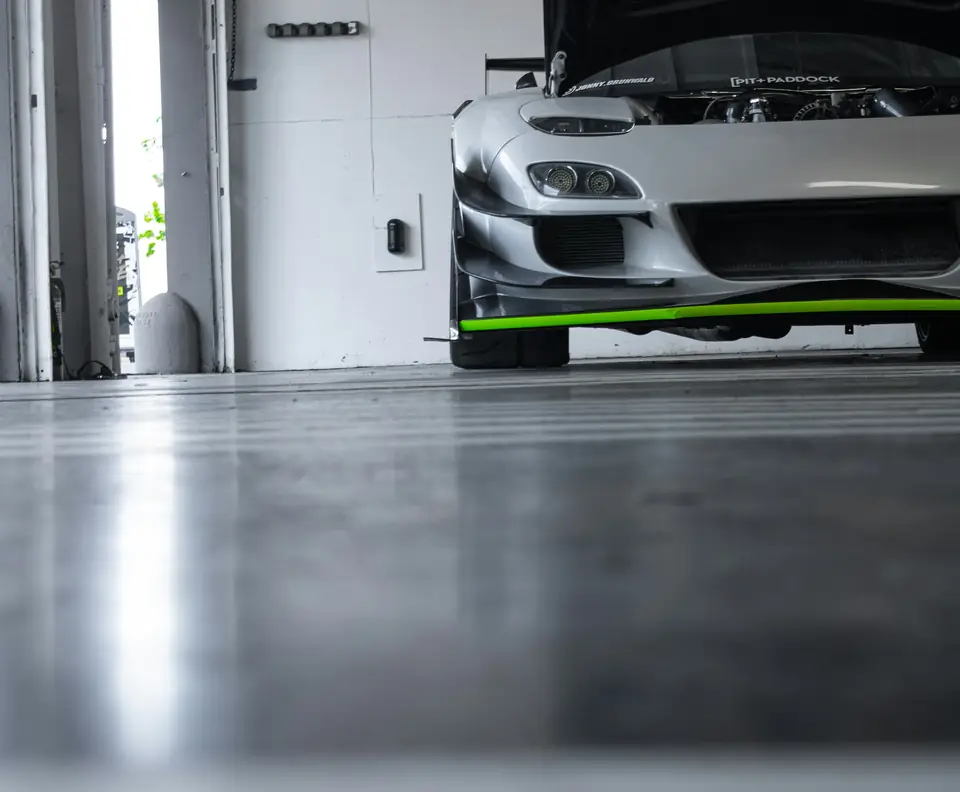
Clear Garage Floor Sealer: What a Sealer Is For, and Where It Stops
Bare concrete is full of tiny connected pores. In a garage those pores pull in salt brine, slush, oil and whatever drips off the car, and every freeze works on the water that got in. A sealer’s whole job is to slow that down: either by lining the pores from the inside (penetrating sealers) or by laying a thin film across them (film-forming sealers). The concrete still looks like concrete, maybe a little darker or shinier.
That is the line between this page and a coating. A clear garage floor sealer won’t hide a stain, fill a pit, level a patch or change the color. If the floor already looks the way you want and you mainly want it to stop soaking up winter, a sealer is the cheapest protection there is. If you want the stains and patches gone, you’re shopping for a coating, and the garage floor epoxy systems page covers that.
Something we lose money sayingA penetrating sealer on a clean, sound, never-coated garage slab is a job plenty of homeowners do themselves with a sprayer and a free Saturday. Where it pays to hire someone is grinding off an old film, dealing with pits at the door, or a floor that needs a real coating anyway.
Search the shelves for a “concrete sealer garage floor” product and every can promises protection. None of them is a moisture barrier for a wet slab or a repair for one that’s cracking. Those show up on the map below.
Eight Spots on a Garage Slab, and Whether a Concrete Sealer Can Handle Them
Walk your own floor with this plan. The answer for each spot is one of three: a sealer helps, the spot needs repair before anything is applied, or it calls for a coating or a different product altogether.
Slab map
Tap a numbered spot on the garage plan, or read the eight findings below it. Each one ends in one of three answers: a sealer helps, it needs repair first, or it needs a coating or a different fix.
Pick a spot to see whether a sealer can handle it.
-
Salt scaling at the door apron Needs repair first
Flaking and shallow pits in the first few feet inside the door, where brine drips off the cars all winter. A sealer slows the next round of scaling but doesn’t put the lost surface back, and sealing over loose flakes seals in the weak layer. Scaled concrete gets ground back to sound material and patched first; then a penetrating sealer is worth having there more than anywhere else on the floor.
Repairing concrete garage floor scaling and spalls -
Oil drip under the engine Needs a coating or a different fix
Oil that has soaked in blocks a penetrating sealer from getting into those pores, and a clear sealer leaves the stain fully visible, sometimes darker. Degreasing and a poultice lighten it; only an opaque coating actually hides it, and even that needs the oil pulled out and the area ground first or the coating won’t stick there.
-
Hairline shrinkage crack A sealer helps
Thin, random cracks from the slab drying out after the pour, usually not moving and not opening further. A penetrating sealer soaks into the crack faces and slows water and brine getting in. It won’t fill or hide the line, so if the look bothers you, that’s a coating conversation.
-
Control joint Needs a coating or a different fix
The saw-cut or tooled lines that tell the slab where to crack. A sealer coats the joint walls but leaves the groove open to collect sand and salt. Closing it takes a joint filler, a separate product, and joints that still move should stay flexible rather than be packed with something rigid.
-
Dusting surface Needs a coating or a different fix
Gray powder on everything stored on the floor means a weak, soft top layer. A penetrating water repellent doesn’t harden it, and a film sealer only glues the dust down until the film wears. A densifier (a silicate treatment that reacts inside the concrete) is the usual first step, or the soft layer is ground off before a coating.
-
White bloom along the stem wall Needs a coating or a different fix
Efflorescence: salts carried out of the concrete by water moving through it, often where the slab meets the foundation wall or where meltwater collects. Seal over it with a film and the moisture pushes the film off or turns it white. Find and stop the water first (grading, gutters, a door seal), clean the bloom off, and only then pick a breathable penetrating product.
-
A builder’s sealer (water beads up) A sealer helps
Common in newer Woodbury garages: the slab was sealed when the house was built, and water sits in beads instead of darkening the concrete. That sealer is doing its job. When the beading stops, a compatible product can go back on. What it does block is any coating, which won’t bond to it until it is ground off.
-
Pitting in the tire paths Needs repair first
Small pits and popped aggregate where the tires sit and wet slush melts. Sealing slows more pitting, but pits that are already open hold water, salt and sand. They get filled and ground flush before a sealer; deep or widespread pitting is usually where a coating starts to make more sense.
Garage floor repair contractors on pits and patching
A self-check to bring to the estimate, not a diagnosis. The same-looking spot can have a different cause on your slab, and some of these need someone to look at the concrete in person.
Silane, Acrylic or Garage Sealer Epoxy: How Deep Each Product Sits
“Sealer” covers products that work in opposite ways. Penetrating silanes and siloxanes soak in and react inside the pores. Acrylics dry into a film on top. An epoxy seal coat is a thin true coating that needs a ground surface to grip. Where each one sits decides what it resists, how it fails and what you’ll be doing in a few years.
Garage floor sealant epoxy is sold in hardware stores as a one-coat kit too. The chemistry can be the same; what usually differs is the grinding underneath.
Sealer depth
Switch products to redraw the slab cross-section. Every write-up is listed under the drawing.
Showing: Penetrating silane or siloxane sealer
Penetrating silane or siloxane sealer
- Where it sits
- Inside the pores of the top of the slab. It reacts with the concrete and leaves no film on the surface. One silane-siloxane product describes itself as “Invisible, non-darkening.”
- Resists
- Water and brine soaking in, which is most of what a Minnesota garage floor needs. The same product sheet: “Formulated to stop moisture and salt penetration.” Because there is no film, vapor can still leave the slab (“No Film. Leaves surfaces breathable.”).
- Doesn’t resist
- Oil, coffee, antifreeze and tire marks: with no film on top there is nothing to wipe clean, so spills still stain. It doesn’t harden a dusty surface, add shine or hide anything.
- Reapplying
- When water stops beading and the concrete darkens quickly after a splash, starting in the tire paths and at the door. The interval is whatever that product’s sheet says; traffic and salt shorten it. Plan on grinding it off before any future coating.
Film-forming acrylic sealer
- Where it sits
- A thin film on top of the concrete. Acrylics often darken the slab and give it a glossy “wet look,” and the final color is hard to predict.
- Resists
- Dust and light dirt; a sealed surface sweeps and mops more easily, and the sheen is what many people picture when they hear “sealed floor.”
- Doesn’t resist
- Hot tires, oil and chemicals. One sealer manufacturer says most common acrylic sealers “do not provide exceptional chemical or stain resistance to the concrete.” The film also wears through first where the tires turn.
- Reapplying
- More often than a penetrating sealer in a parked-in garage, and carefully: applied to damp concrete or built up too thick over the years, an acrylic turns white and eventually peels.
Epoxy seal coat (garage sealer epoxy)
- Where it sits
- A thin, two-part epoxy film bonded to concrete that has been ground first. Even thin coatings need a profile: one industry summary calls for CSP 3 for coatings of 4 to 5 mils.
- Resists
- Oil, most household chemicals and brine better than an acrylic film, and it wipes clean. It is the cheapest way to get a real coating on the floor.
- Doesn’t resist
- Sun and wear. Plain epoxy can amber where daylight hits it through the door, which is why one epoxy data sheet recommends a topcoat “for added UV stability and abrasion resistance.” A single thin coat also wears through in tire paths and can lift at a salted door edge.
- Reapplying
- Before it wears through. A worn seal coat gets scuffed and recoated; once it starts peeling, it has to come off where it lifted.
Full coating system
- Where it sits
- Several layers on top of a ground slab: a base coat, usually a broadcast of flake or quartz, and a topcoat, many times thicker than a seal coat.
- Resists
- The most of everything on this list, and it is the only option here that hides stains, color differences and small patches.
- Doesn’t resist
- A slab that is too wet for the product, or cracks that keep moving. Those still show up as peeling or cracks in the coating later.
- Reapplying
- Usually a topcoat refresh years later rather than a reapplication; the system and the installer’s scope should say.
Drawing not to scale. Product behavior varies by brand and by slab; the data sheet of the product actually used decides prep, coverage and recoat timing.
What an Epoxy Seal Garage Floor Job Involves
The prep is nearly the same as for a full system, which surprises people. The slab is diamond ground to open the surface, cracks and pits are filled, the dust is vacuumed off, and the air and slab temperature are checked against the dew point before mixing. Then one or two thin coats of clear or tinted epoxy go down, with no broadcast and often no separate topcoat.
So most of the labor is already spent by the time the epoxy goes on. What you save is material and a day, not the grinding.
Epoxy Floor Sealer or a Full System: When the Thin Coat Is the Better Buy
- The garage is used for storage, a workshop or one car that comes in dry, not two cars carrying slush every day.
- The slab is in good shape and you like how it looks; you want it wipeable, not transformed.
- A basement utility room, a shed or a shop where daylight barely reaches the floor, so ambering in sun isn’t a concern.
- You want a clear epoxy floor sealer now and may build a flake system on top of it later, which works if the seal coat is still well bonded.
Where it isn’t: a two-car garage that takes winter brine every day. A single thin film over the door apron and in the tire paths is the first thing to wear through and lift, and we won’t put a number of years on it, because in a Woodbury garage the salt, not the calendar, decides. For daily parking, a full system, with a broadcast and a UV-stable topcoat such as a polyaspartic topcoat, usually costs less per winter it lasts.
Salt, Brine and Sealed Concrete in Woodbury Garages
The Twin Cities (MSP) average roughly 75 days a year when the temperature crosses the freezing mark: below 32°F overnight, above it in the day. That is our arithmetic on NOAA’s 1991-2020 normals, not an official freeze-thaw count, but every one of those days can freeze whatever water sits in the top of a garage slab.
Road salt makes it worse. The Pennsylvania Aggregates and Concrete Association puts it plainly: “Deicers tend to amplify freeze-thaw deterioration which can lead to surface defects and possible structural failure.” The same sheet says a sealer “will also prevent chloride-laden moisture from migrating into the concrete slab,” which is the best one-sentence case for sealing a garage floor in this climate.
- New slab? The same association recommends that deicers not be used in a pavement’s first year. On a brand-new Woodbury driveway and apron, shovel and use sand that first winter.
- Never ammonium deicers. Ammonium sulfate and ammonium nitrate “will easily destroy a concrete surface.” Read the bag.
- Less salt works. The MPCA suggests less than four pounds of salt per 1,000 square feet, about four heaping 12-ounce coffee mugs, and notes most salts stop working at 15°F.
- Squeegee, don’t hose. A sealed floor lets brine sit on top long enough to push it out the door with a squeegee instead of washing it into the floor drain.
That last point matters past the garage. By the MPCA’s count, a single teaspoon of deicing salt is enough to pollute five gallons of water for good, and two Woodbury lakes, Battle Creek and Carver, appear on the East Metro Water list of waters impaired by chloride. A floor that sheds brine instead of soaking it up lets you use less salt on the driveway and send less of it downstream.

About three in four Woodbury homes were built in 1990 or later, so many garage slabs here have already been through two or three decades of this. Pitting by the door is common at that age; it is also the spot to seal first, once it is repaired.
Polished Concrete Flooring in a Garage: How Much Aggregate Shows
Polishing doesn’t add a layer. Polished concrete floor contractors grind the slab itself with progressively finer diamonds, usually treat it with a densifier that hardens the surface, and polish it until it reflects light. How deep the first grind goes decides how much of the stone inside the concrete shows, and the industry describes that in exposure classes.
The Concrete Polishing Council also changed how shine is judged: its appearance chart now rates the floor by distinctness of image and haze rather than gloss alone, because many in the trade felt a gloss reading could be easily manipulated. When polished concrete contractors quote a “level,” ask which chart they mean.

Aggregate levels
Pick a level to read what the grinding depth means for your slab. The swatches only suggest how much stone shows; they are not colors.
-
Class A: Cream Approximate cut on the older chart: Very little
- What it shows
- The cement paste on top of the slab, with little or no stone showing. It looks the most like the original floor, trowel marks and all.
- What the grinding means
- The lightest grind of the four. Every surface flaw stays, because nothing is being removed to hide it: patches, old stains and trowel swirls read right through the polish.
- Garage slab?
- A candidate only if the top of the slab is still hard and clean. On a 25-year-old garage that has been salted, the cream at the door is usually the part that is gone already.
-
Class B: Salt and pepper (fine aggregate) Approximate cut on the older chart: 1/16 inch
- What it shows
- Speckles of sand and the tips of small stone through the paste. Busy enough to hide grit and minor wear.
- What the grinding means
- Deep enough to cut through most surface staining and light scaling, shallow enough that the slab keeps most of its dense top.
- Garage slab?
- The most practical polished look for a garage slab in fair shape. Repairs still show as a different-colored patch, so expect to see where the pits were.
-
Class C: Medium aggregate Approximate cut on the older chart: 1/8 inch
- What it shows
- Clearly visible pieces of stone across the floor, a terrazzo-like look.
- What the grinding means
- More passes, more dust and slurry to manage, and more of the slab removed. Low spots stay creamier than high spots, so the floor has to be fairly flat to look even.
- Garage slab?
- Possible on a flat, sound slab, but it is a showroom finish for a garage, and the effort is closer to a full coating job.
-
Class D: Large aggregate Approximate cut on the older chart: 1/4 inch
- What it shows
- Large stone faces dominate the floor.
- What the grinding means
- The most aggressive grind. It opens air voids and pits that then need filling, and how the stone looks depends entirely on what aggregate the ready-mix truck happened to carry when the slab was poured.
- Garage slab?
- Rarely a sensible garage choice. On a residential slab you can’t see the stone before grinding, so nobody can promise what it will look like.
The four classes and cut depths above come from the older chart that many specs still quote. The Concrete Polishing Council’s revised chart uses three classes (A cement fines, B fine aggregate, C coarse aggregate), defines them by the share of the surface each material covers, and dropped both the medium class and the cut depths. Which one you actually get depends on how your slab was mixed and finished; nobody can guarantee it before grinding.
Where polished concrete earns its place in a garage
- No film to peel or lift under hot tires, and nothing to recoat.
- A bright, reflective floor that sweeps and dust-mops easily.
- A good fit for a sound, flat slab in a display garage, shop or showroom; for larger spaces, see industrial epoxy floors for warehouses and showrooms to compare.
Where polished concrete in a garage disappoints
- The slab has to be in good shape. Patches, filled pits and repaired cracks show as different-colored spots; polishing reveals the slab rather than covering it.
- It is still concrete. Oil drips will stain it unless a stain guard or sealer goes on after the polish, and that guard needs reapplying in a working garage.
- A salt-scaled door apron can’t be polished out without grinding deep, and it can get slick when snowmelt is on it.
An honest note from a concrete floor polishing company: polishing is rarely our first suggestion for a home garage, even though it is the bigger job. Most Woodbury garages are better served by a sealer, or by a coating if the slab needs hiding.
What to Ask Garage Floor Sealing Companies Near Me Before Anyone Starts
Sealing is quick, which is why it gets bid loosely. These are the answers worth having on paper:
- Which type of product: penetrating, acrylic film or epoxy, and its name, so you can read the data sheet yourself.
- The prep: a wash and degrease, or diamond grinding. Anything that films over the slab needs grinding.
- What happens to an existing builder’s sealer or old film, and how they checked for one.
- Which spots get repaired before sealing (the door apron and tire-path pits), and which are left as they are.
- The air and slab temperature they need on the day, and how long before you walk and park on it.
- When they expect it will need reapplying, and what that visit involves.
If the honest answer for your floor is a coating instead, we’ll say that too; the full epoxy floor coating options are on our homepage.
Sealer and Polished Floor Answers: Reseal Timing, Winter, Oil and Radon
How often does a sealed garage floor need resealing?
There is no honest single number. It depends on the product, how many cars park on it, and how much brine they bring in. Watch the tire paths and the first few feet inside the door: when water stops beading there and the concrete darkens right after a splash, it is time. A penetrating sealer can be reapplied over itself; an acrylic film needs to be cleaned and checked for buildup first.
Can a garage floor be sealed in a Minnesota winter?
Usually not well. Sealer data sheets set minimum air and slab temperatures, and the Twin Cities (MSP) normal high stays below 42°F from November through March. A winter slab is also full of salt water, which a sealer would lock in. The better window is late spring through early fall, after a thorough wash and a few dry days.
Will sealing hide oil stains on the garage floor?
No. A clear sealer leaves stains visible and can make them look darker, and oil in the pores keeps a penetrating sealer from soaking in there. Degrease and poultice the stains first and accept what remains, or choose an opaque coating, which still needs the oil pulled out before it can bond.
Can the floor be coated later if we seal it now?
Yes, but sealing now adds a step later. Both penetrating and film sealers keep a coating from bonding, so whoever coats the floor will grind the sealed surface off first. If a full coating is likely within a few years, it can be cheaper to skip the sealer and save toward the coating.
Is polished concrete slippery in a garage?
It can be when snowmelt is on it. A smooth, polished surface gets slick when wet, and a garage floor is wet for much of the winter. Keep a mat where you step out of the car, and talk through the finish level before choosing a high-gloss polish for a garage.
Does sealing the garage slab help with radon?
Not on its own. The Minnesota Department of Health treats sealing cracks and openings as one part of a radon mitigation system built around a fan and pipe, not as a fix by itself. A radon test tells you the level; a garage floor sealer doesn’t change that answer.
Sources and data sheets cited on this page
- AQUAPEL silane-siloxane sealer product page (penetrating sealer example, Laticrete): ca.laticrete.com/en/products/aquapel-aquapel-plus
- Diagnosing 5 common concrete sealer problems (Euclid Chemical): euclidchemical.com/company/blog/archive/diagnosing-5-common-concrete-sealer-problems/
- Ghostshield Epoxy Max 100 TDS (epoxy example; topcoat for UV stability): cdn.shopify.com/s/files/1/2077/9359/files/100_TDS_v.1.pdf
- Concrete surface profile visual scale (Clemtex, after ICRI): archive.clemtex.com/literature/files/concrete-surface-profile-visual-scale.pdf
- Scaling and deicers product sheet (Pennsylvania Aggregates and Concrete Association): www.pacaweb.org/uploads/documents/PIS_Scaling.pdf
- Smart Salting flyer (MPCA): www.pca.state.mn.us/sites/default/files/p-tr1-45.pdf
- Statewide Chloride Management Plan summary (MPCA): www.pca.state.mn.us/sites/default/files/wq-s1-94a.pdf
- Chloride-impaired waters in Washington County (East Metro Water): eastmetrowater.org/2023/06/18/state-of-the-lakes-in-washington-county/
- NOAA 1991-2020 normals, MSP (monthly and annual): www.ncei.noaa.gov/data/normals-annualseasonal/1991-2020/access/USW00014922.csv
- Year structure built, Woodbury (ACS 2024 1-year, B25034): api.censusreporter.org/1.0/data/show/latest?table_ids=B25034&geo_ids=16000US2771428
- Polished concrete aggregate exposure classes and cut depths, older chart (Concrete Network): www.concretenetwork.com/concrete/polishing/levels.html
- Concrete Polishing Council of ASCC revises its aggregate exposure and appearance charts (Concrete Decor): concretedecor.net/?p=26180
- Radon mitigation systems (MDH): www.health.state.mn.us/communities/environment/air/radon/mitigationsystem.html