Epoxy Flake Garage Floor Systems in Woodbury, MN
Chips thrown into a wet base coat until it won’t hold another, scraped, then locked under a clear topcoat. It’s a forgiving finish for a working garage, and the one where an estimate hides the most detail.
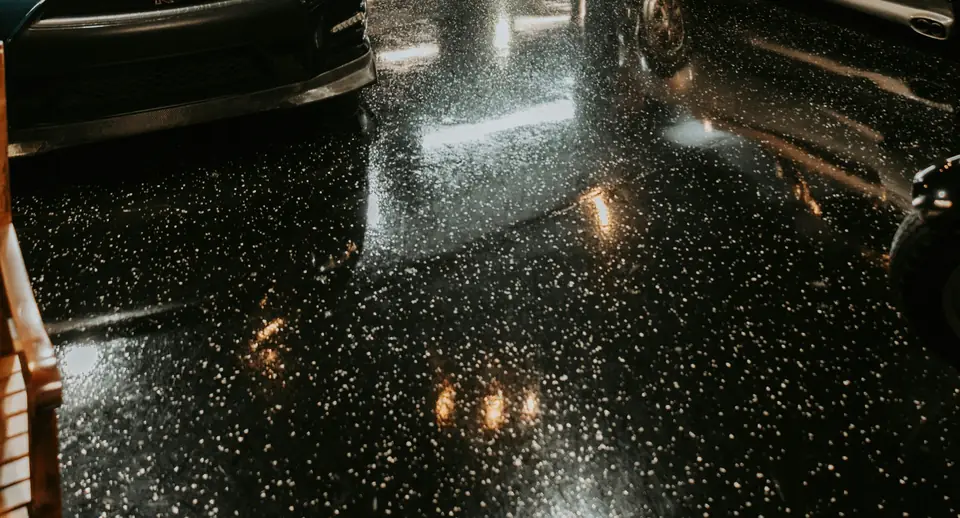
The photo is marked up: tap a number to see what a chip floor shows and hides.
Read the floor: pick a number
-
How full the broadcast is. Here the dark base shows between light chips. On a garage floor broadcast to refusal you would see no base color at all, only chips touching chips, and the color comes from the blend.
-
Gloss is the topcoat, not the chips. The mirror streak is light on the clear topcoat. The chips themselves are matte; one flake maker lists its chips under 15 gloss units.
-
Standing height vs. crouched. From standing height a chip floor blends into one tone. Crouch down and you see individual chips, and any edges that the topcoat didn’t fully bury. Judge a sample board both ways.
-
Tire paths wear first. The topcoat dulls first where tires turn and stop. That shows as a matte lane long before chips wear, and it’s the part a later recoat renews.
-
Mixed color hides film. Varied chip colors hide a dried film of road sand and salt between cleanings. A one-color floor, dark or light, shows that film soon after the snow starts.
What a Garage Flake Floor Is Built From
A flake floor is a full coating system with chips in the middle of it. It isn’t paint with confetti on top. One flake maker’s data sheet draws it from the concrete up as an optional primer, a pigmented base coat, the flake, and clear topcoat. That matches how we build one, after the concrete is diamond-ground and repaired.
- Base coat. A pigmented coat rolled out in sections, close to the chip color so any gap reads as part of the blend.
- Chips broadcast to refusal. While the base is wet, chips are thrown up and out so they fall evenly, and the crew keeps throwing until the base coat won’t take any more. A full broadcast leaves no base showing.
- Scrape and vacuum. Once the base cures, loose chips are swept up and the floor is scraped so chip edges lie flat. Skip this and the topcoat drapes over sharp edges.
- Clear topcoat. One or two clear coats bury the chips and carry the wear. The chips are about 5 mils thick on one maker’s sheet, so the topcoat has real work to do.
A partial broadcast, where chips are scattered over a solid color, uses fewer chips and lets the base color lead. It looks lighter and costs less in material, but each chip is only as tough as the base and topcoat holding it.
Garage Floor Speckles: What the Chips Cover and What They Don’t
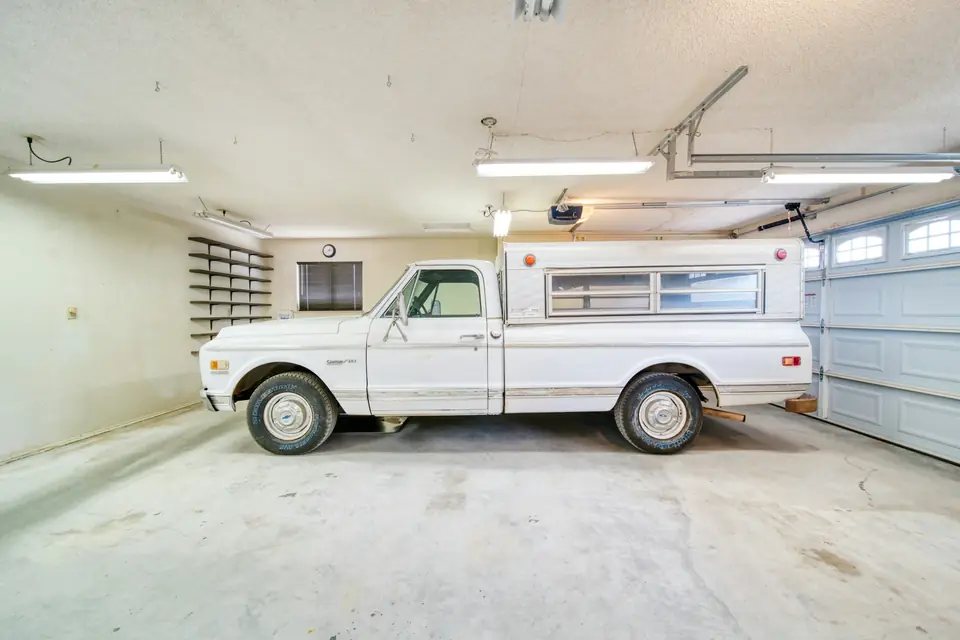
Most people shopping for decorative chips for garage floor work are looking at a slab like this one: blotchy, stained, patched at some point, and dull. Roughly three in four Woodbury housing units were built in 1990 or later, so a lot of garages here are 20 to 35 years into the same story. Chips are very good at making that slab look new. They don’t make it sound.
Hidden by a full broadcast
- Oil and rust stains, tire marks and color blotches
- Patches that don’t match the old concrete
- Grind marks and small surface texture
- A film of sand and salt between cleanings
Still there under the chips
- Cracks, unless they are filled first, and a crack that moves can return
- Pitting and scaling by the door, which has to be filled flush
- A heaved or sunken section; chips follow the shape
- Moisture vapor from below; one flake maker notes its chips don’t stop efflorescence
- A weak bond: hot-tire pickup, where a warm tire lifts a patch of coating, starts with poor prep, and chips don’t change that
That second list is why our estimate for an older slab has a repair line, and why it may come in above a bid that doesn’t. If the slab is sound and you only want it cleanable, a clear sealer may be the cheaper honest answer; see our sealing and polishing options.
Epoxy Chip Flooring at the Stem Walls, House Step and Door Apron
The open floor is the easy part. Edges are where two bids for the same garage stop matching, and where a coating starts to fail if it’s detailed badly. They’re also mostly hand work, so they cost time. Here is each edge of a typical attached garage, from the wall by the house to the overhead door.
Garage edges, in section
Pick a numbered zone, in the drawing or the buttons, to see whether chips run there and how it's finished.
-
Stem wall Yes, as extra hand work
- Can chips run here?
- Yes. The concrete curb along the wall can take the base coat and chips to its top edge or to a straight line you pick.
- How it's detailed
- The face is ground or hand-sanded, the base coat is brushed on, chips are thrown and pressed into it by hand, then it’s topcoated. In Washington County, Minnesota’s code puts footings at least 3-1/2 feet down, so an attached garage usually sits on a frost wall, and the part above the slab is this stem wall. A one-story detached garage of 1,000 sq ft or less may be built slab-on-grade, with no curb at all.
- Decide or ask
- Top of the curb or a fixed height? Is it priced by the linear foot, and is it on the estimate or assumed?
-
Cove at the wall Optional
- Can chips run here?
- Chips can follow a cove, the small curved fillet between floor and wall, or the coating can simply turn a square corner.
- How it's detailed
- A cove is formed with a thickened paste before the base coat, so there’s no sharp inside corner to collect grit and water. It’s more common in commercial work; in a home garage it’s a choice, not a rule.
- Decide or ask
- Square corner or cove? If a cove, what is it built from, and does it run behind shelving that’s staying?
-
Step to the house Yes, tread and riser
- Can chips run here?
- Yes. Tread and riser can match the floor.
- How it's detailed
- The step is often a separate pour, so the joint where it meets the slab gets filled first. The front edge takes the most wear, and the tread is where wet boots land, so it is the first place to add grit to the topcoat.
- Decide or ask
- Are tread, riser and sides included? Will the tread get an anti-slip additive even if the floor doesn’t?
-
Floor field Full broadcast
- Can chips run here?
- Yes. This is the main field, broadcast until the base coat takes no more chips.
- How it's detailed
- Cracks are filled and ground flush before any base coat. Saw-cut control joints are either filled and coated over, or kept open and re-cut; a crack that is still moving can show through any topcoat later.
- Decide or ask
- Which joints get filled and which stay open? What happens if a filled crack reopens?
-
Floor drain (if any) Stops at the grate
- Can chips run here?
- Up to the drain, not into it. Not every garage has a floor drain; if yours does, it gets its own detail.
- How it's detailed
- The grate comes out, the coating is carried to the drain body’s edge without building up a lip, and the slope toward the drain is kept. Chips stay out of the throat.
- Decide or ask
- Will the grate be removed and reset? Does water still run to the drain once the coating is down?
-
Door seal and apron Clean stop line
- Can chips run here?
- Inside the door, yes. The coating stops at a straight line under the overhead door’s rubber seal, not out on the driveway.
- How it's detailed
- A feathered edge is where coatings start to lift, so many installers grind or cut a shallow groove at the stop line for the coating to lock into. On 1990s and 2000s slabs the first few feet inside the door are often pitted from salt drip and get filled before the base coat.
- Decide or ask
- Exactly where does the coating end, and is that edge keyed in? Does the door seal need adjusting so it closes on the new floor?
A schematic, not drawn to scale or from any real garage. What your edges need is decided on site.
Reading a Speckled Garage Floor Estimate
Two estimates for the same garage can be far apart in price and both be honest. The difference is in the lines. A short one-line bid for a chip floor leaves you guessing which of these it includes.
Hold any bid, ours included, against this sheet. A line that isn’t written down is a line you can’t hold anyone to.
Mock estimate: click a line
Written estimate: flake floor, attached garage
-
What it means: The grinder opens the concrete so the base coat can bond. One epoxy data sheet asks for ICRI CSP 3 to 4 “by appropriate mechanical means”; an acid wash only reaches the CSP 1 end of that scale.
Ask: Which profile, and how is it checked? Is a builder’s sealer or old paint being ground off, and is that included?
-
What it means: Filling and grinding flush everything the chips would otherwise sit over. Grinding usually uncovers more than you can see on a dirty floor.
Ask: Is there an allowance for what the grinder finds, and what does extra cost per foot? A bid with no repair line is assuming a perfect slab.
-
What it means: The colored layer the chips are thrown into. Its color matters most in a partial broadcast; in a full broadcast it mostly disappears.
Ask: Epoxy, polyurea or polyaspartic base? What are its temperature and dew point limits? One epoxy sheet sets 50°F minimum and 5°F above the dew point.
-
What it means: One flake maker’s data sheet lists roughly 5 to 7 sq ft per pound for a full broadcast of 1/4-inch or 1/8-inch chips, against 25 to 50 for heavy and 50 to 200 for light coverage, and calls those approximations.
Ask: Full broadcast to refusal, or a lighter scatter? Pounds of chips divided into your square footage tells you which one is priced.
-
What it means: After the base cures, loose chips are swept up and standing chip edges are scraped down so the topcoat can cover them.
Ask: Is this a full scrape of the floor? It decides how sharp the floor feels barefoot.
-
What it means: The clear layer that carries the wear and the gloss. One flake maker recommends a clear topcoat “to fully encapsulate” its flakes.
Ask: Which chemistry, how many coats, and is any aluminum-oxide grit added? Topcoat build sets both durability and texture.
-
What it means: Coating up the curb and the step to the house. It’s slow hand work and the line most often left off one bid and on another.
Ask: Included or extra? Same blend and topcoat as the floor?
-
What it means: Product times at a stated temperature. One polyaspartic sheet lists vehicle traffic at about 24 hours at 77°F; one epoxy sheet lists light traffic after about 3 days at 50°F. A cold slab stretches every number.
Ask: At what slab temperature are these dates? One topcoat sheet warns that early traffic can mean “loss of aggregate”, which on this floor means chips.
-
What it means: What isn’t in the price. Common ones are a moisture-tolerant primer if a test fails, moving shelving and freezers, and repairs beyond the allowance.
Ask: What triggers each exclusion, and who decides? Get the answer before the grinder starts, not after.
Total and dates: written in after the slab is seen and the system is chosen.
A mock sheet for reading real estimates, not a quote. The blanks are blanks on purpose: no quantity, rate or price here is ours.
Texture and Grip on a Flake Floor: Chip Size and Topcoat Build
A chip floor gets its texture from two settings: how big the chips are and how much clear goes over them. Larger chips under a single topcoat leave a faint ripple you can feel. The same chips under a second topcoat feel nearly smooth, and smooth plus snowmelt is the slippery combination. One flake maker lists its chip texture as an anti-slip feature, but that texture shrinks with every coat of clear.
When more grip is wanted, an aluminum-oxide additive goes into or onto the topcoat. One manufacturer’s data sheet describes its aluminum-oxide additive as one that “can be broadcast ... into the wet coating with or without decorative chips.” That is how a step tread or the first stretch inside the door gets extra grip without roughening the whole floor.
In a Twin Cities winter that first stretch matters. Cars bring slush and brine in from November to March, and Woodbury’s Battle Creek and Carver Lakes are listed as chloride-impaired, so squeegeeing brine out the door beats washing it down the drain. A floor you can squeegee easily and still walk on wet is the target.
About slip numbersThe figure you’ll see quoted, a wet DCOF of 0.42 or higher under ANSI A326.3, is a published benchmark for tile on level interior floors, and the tile maker that explains it adds that values of 0.42 or more “are not necessarily suitable for all projects.” One epoxy data sheet reports a coefficient of friction of 0.6 under ANSI 326.3 for that one coating. No single number covers “a flake floor”; ask for the tested value of the exact topcoat and grit you’re buying.
Before the Chips Go Down: Flake Floor Questions
How soon can I park on a new flake floor?
It depends on the base and topcoat chemistry and on the slab temperature, so the estimate should state it. Published examples: one polyaspartic data sheet lists vehicle traffic after about 24 hours at 77°F; one epoxy data sheet lists light traffic after about 2 days at 68°F and about 3 days at 50°F, with full cure after 7 to 10 days. Parking early can tear chips out of a soft topcoat.
Is October too late to put chips down in a Woodbury garage?
Early October usually works; late October gets tight. The Twin Cities (MSP) normal high is 58.1°F in October and 41.9°F in November, and the median first fall freeze is October 18. The data sheets we cite set minimums between 40°F and 50°F for air and slab, and an attached garage slab cools slowly but it does cool. We would rather move you to spring than coat a slab that’s too cold to cure.
Will the chips fade where sun comes through the door?
Some colors can. One flake maker rates each color’s lightfastness and says colors with poor ratings “are not recommended for applications with direct sun exposure.” If your door faces south or west and stays open on summer afternoons, ask for the rating of every color in the blend, and for a topcoat that holds its color in sun.
What chip size should a two- or three-stall garage use?
The common sizes are 1/4-inch, 1/8-inch and 1/16-inch, plus a large 1-inch flake one manufacturer lists. Quarter-inch is a common garage choice and hides grit well. Smaller chips read finer and pack tighter, and need more pounds per square foot to cover. Look at a sample board on the floor in daylight before choosing.
Can a flake floor go over an old coating or painted concrete?
Not over it as-is. Paint and failing coatings get ground off until clean concrete shows, because the new base coat is only as well bonded as the layer under it. If the old floor is peeling, read up on removing peeling or failed coatings first.
Does a flake floor feel rough underfoot?
Slightly textured, not sharp, if the chips were scraped and the topcoat covered them. A floor that snags socks usually got a thin topcoat over unscraped chips. Extra topcoat smooths it; extra grit roughens it. You choose where it lands.
Start a Flake Floor Estimate
Tell us the stall count, roughly how old the slab is, and whether you want the stem walls and step done. A photo of the worst spot by the door helps more than a photo of the whole garage.
We look at the concrete before we write a number, and the estimate comes back with the lines above filled in. If the slab needs more repair than a chip floor is worth, we’ll say that too.
Sources and data sheets cited on this page
- Torginol FLAKE Flooring technical data sheet (2026): sizes, coverage, lightfastness, topcoat: assets.torginol.com/uploads/FLAKE-FLOORING-TDS-2026.pdf
- Sikalastic-748 PA product data sheet (polyaspartic broadcast/topcoat example): usa.sika.com/content/dam/dms/us01/r/sikalastic_-748_pa.pdf
- Sikafloor-264 product data sheet (epoxy example: CSP, temperature, cure, friction): industry.sika.com/content/dam/dms/us01/g/sikafloor_-264.pdf
- APF Polyaspartic 7500 Low Odor PDS (vehicle traffic example): apfepoxy.com/cdn/shop/files/APF_Polyaspartic_7500_LowOdorMC_PDS__07.18.25.pdf
- Rust-Oleum Anti-Slip Additive TDS (aluminum oxide): images.homedepot-static.com/catalog/pdfImages/d9/d9d61082-cb14-498f-9542-39453bba47ab.pdf
- ANSI A326.3 and DCOF 0.42 for tile (Crossville): www.crossville.com/learn/porcelain-tile-dcof-ratings-and-applications/
- Concrete surface profile visual scale (Clemtex, after ICRI): archive.clemtex.com/literature/files/concrete-surface-profile-visual-scale.pdf
- Minnesota Rules 1303.1600 (footing depth by zone; slab-on-grade garages): www.revisor.mn.gov/rules/1303.1600/
- NOAA 1991-2020 monthly normals, MSP: www.ncei.noaa.gov/data/normals-monthly/1991-2020/access/USW00014922.csv
- NOAA 1991-2020 freeze dates, MSP: www.ncei.noaa.gov/data/normals-annualseasonal/1991-2020/access/USW00014922.csv
- Year structure built, Woodbury (ACS 2024 1-year, B25034): api.censusreporter.org/1.0/data/show/latest?table_ids=B25034&geo_ids=16000US2771428
- Chloride-impaired waters in Washington County (East Metro Water): eastmetrowater.org/2023/06/18/state-of-the-lakes-in-washington-county/